
*This post contains affiliate links and may earn commissions on recommended products. As an Amazon Associate, I earn from qualifying purchases.
Want to save this recipe for later?
Are you a food writer or just want to learn more about creating recipes? Don’t know how to open your pantry and create a meal from what’s inside?
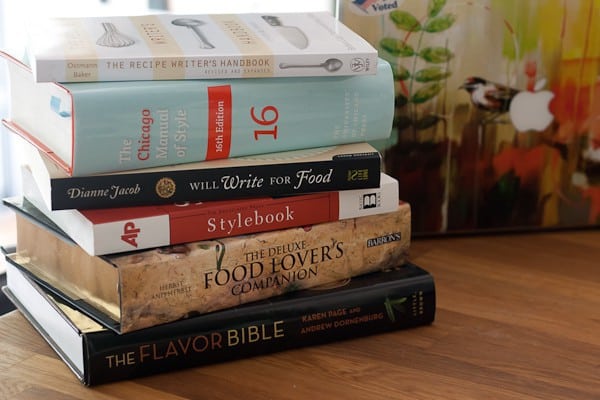
These are my essential reference books that I refer to constantly. I’ve been working in food writing for nearly two decades, and before that I was a professional copyeditor.
Not a single day at the office went by without me grabbing one of the reference books off the shelf, and it’s much the same with recipe development and writing. From spelling to deciding the exact right herb to use with butternut squash, those books are essential to my work. It’s not that I have to look everything up—but a successful worker knows their tools and when to rely on them.
These books are guaranteed to make a you better writer and feel more comfortable in the kitchen. And if you’re looking for something to give a food-loving friend, they’re a great start to their collection!
Ingredient Reference
These books are essential for learning about what ingredients go with each other, what kinds of swaps you can make for similar recipe results, or just if you want to know about all the different kinds of dried chiles.
The Flavor Bible by Karen Page and Andrew Dornenburg – If you have no other book on this list, at least have this one. It will help you develop recipes, find a missing ingredient to an old one (you know, when a dish just needs something), and just plain get dinner on the damn table. The ultimate cure for stuffing every candy inside every baked good.
The Vegetarian Flavor Bible by Karen Page – Just as helpful as its omnivore edition, this book focuses on vegetarian ingredients (including dairy). It’s actually bigger than the other book and gets more specific in certain categories, so I turn to this one more than the original.
The Deluxe Food Lover’s Companion by Sharon Tyler Herbst – Like a dictionary of food. Do I sometimes get lost reading the cheese section? Yes. It’s helpful if you have trouble spelling specific terms that aren’t in a general spellcheck program, like learning about the history of food, or are researching different kinds of nuts. There’s also an updated paperback, but I think this one is better.
The Food Substitutions Bible by David Joachim – A fantastic reference for finding swaps to both common and not-so-common ingredients from agave nectar to zungenwurst. There are also great appendices in the back with guides on beans, mushrooms, coffee, and more.
Recipe writing reference
The Recipe Writer’s Handbook by Barbara Gibbs Ostmann – Did you realize that your recipes need a proper format? For instance, you need to decide whether to write T. or tbsp. or tablespoon, if you want to write “eggplant” or “aubergine”, and if you want to divide out ingredients for different recipe components or write “2 cups sugar, divided.” This book has great lessons in writing clear recipes for other cooks.
Will Write for Food by Dianne Jacob – A perennially popular choice for food writers. Whether you are just starting out or need a refresher, this book guides you through creating your voice, starting a career in food writing, and the cookbook writing process. There are helpful exercises throughout to hone what you just learned as well.
The Complete Recipe Writing Guide by Raeanne Sarazen – I refer to this one as a recipe writing and development textbook. It’s extremely detailed and informative, with specific sections about developing recipes to lower sugar or fat, developing for special diets, figuring out nutritional analysis, and even recipe photography and styling.
The Book of Yields by Francis Lynch – This book is mainly for restaurant chefs who need to price out recipes, but it’s very helpful for getting the average sizes of ingredients, or how much a cup of sliced strawberries would weigh.
General writing reference
The Chicago Manual of Style or The Associated Press Stylebook – Essential style guides! Chicago is the one most used for magazines and books, and AP is for newspapers, so they have slightly different style guidelines. I like Chicago better because it has much more in-depth information on all manner of topics, but it is a little harder to find what you’re looking for if you’re new to it. The AP book is assembled more like a dictionary, and the bulk of the book deals with proper spelling and capitalization of terms. New editions of both books come out every few years, but a used copy will serve you just fine.
There are also online editions of both of these, but you’ll need a subscription.
Reference cookbooks
These cookbooks don’t just give you recipes, they walk you through foundational techniques that will help you get better in the kitchen.
Salt, Fat, Acid, Heat by Samin Nosrat – This book is divided into four elements, with charming illustrations and recipes to help you explore each one.
The Food Lab by J. Kenji Lopez-Alt – At nearly 1,000 pages, this one is definitely a tome, but it’s a very thorough guide that really explores the science behind cooking.
Mastering the Art of French Cooking by Julia Child, Louisette Bertholle, and Simone Beck – The O.G.
What books do you refer to for writing?
About Megan
I learned how to cook by exploring seasonal ingredients, and you can too! Meal time shouldn’t be stressful or complicated, and with fresh ingredients and easy methods, I’m here to help you enjoy the time spent in the kitchen. Read more…





I’m one of those that say I’m not a writer but of course I am…it’s just not why I decided to blog about food. I have had to embrace that part of the process which is a bit weird since I was an English major in college and used to love to write.
You’ve got some great resources for those that want to improve on this skill; nice post.
Great resource suggestions! I am always looking to expand my library of “go-to” material. Looking forward to checking these out!
Have been meaning to check out the Flavor Bible for a while now. I have the Flavor Thesaurus which I do like, but admit that it can sometimes feel a little overwhelming with its cover to cover text.
I devoured Will Write for Food a few years ago. I definitely am one of those who say “I’m not a writer”. Thank you for your shares!
“Grab the Gibbs!” I can’t tell you how many copies of that book I went through while working in food marketing. Great book.
I couldn’t agree more. I have all of these and frequently flip through them for inspiration.